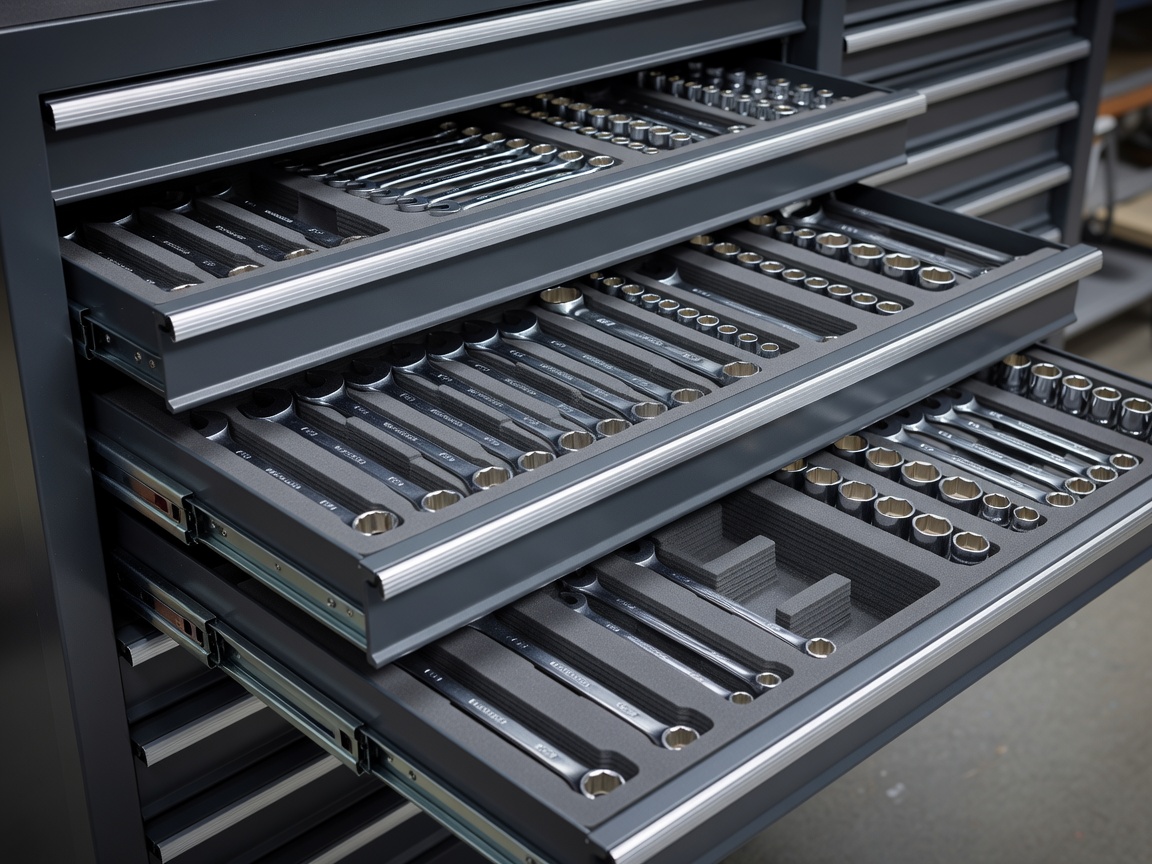
1. Slide Selection: Ball-Bearing Mechanics and Load Classes
The operational lifespan of any tool cabinet is determined by its drawer slide mechanics. Standard residential furniture drawer runners use light stamped-steel tracks rated for 35 to 50 lbs. Under the weight of chrome-vanadium socket sets, hammer drills, or cast-iron hand planes, standard slides will bind, deform their ball cages, and fail within months.
Workshop tool storage demands full-extension, side-mount ball-bearing slides cold-rolled from hardened carbon steel. Full extension is essential: without 100% drawer travel, tooling positioned in the rear 4 inches remains inaccessible without blindly reaching under the cabinet face frame.
| Slide Rating Class | Dynamic Weight Rating | Extension Profile | Typical Tool Application |
|---|---|---|---|
| Standard Heavy-Duty | 100 lbs (45 kg) | 100% Full Extension | Pliers, Screwdrivers, Chisels |
| Industrial Extra-Heavy | 200 lbs (90 kg) | Over-Travel (+1 inch) | Socket Trays, 1/2" Impact Wrenches |
| Ultra Commercial / Cargo | 500 lbs (225 kg) | Full Extension Lock-In/Out | Circular Saws, Cast Iron Routers |
2. Shadowing Organization: Kaizen Layered Foam Systems
A disorganized drawer produces lost shop time. Kaizen layered polyethylene foam (available in 20mm, 30mm, and 57mm sheet thicknesses) allows tools to be nested flush into precise custom cutouts. The multi-layered construction enables custom finger-peeling of cavity depths in 1/8-inch increments.
- High-Contrast Visual Feedback: Employ two-color layered foam (black top face over bright yellow or safety red core). When a tool is in use on the workbench, the vacant red silhouette signals immediately that a piece of equipment has not been returned to its station.
- Finger Relief Ports: Every carved cavity must feature a circular 1-inch semicircular thumb-and-finger cutout. Without finger ports, operators are forced to pry tools out by their cutting edges or delicate adjustment knobs.
- Tool Spacing Density: Maintain a minimum 3/4-inch web wall between adjacent tool cutouts. Narrower foam walls collapse under lateral pressure when heavy hand tools are returned repeatedly to their slots.
3. Mobile Bases & Polyurethane Caster Dynamics
Mobile cabinetry provides crucial spatial flexibility in compact two-car garages, enabling woodworkers to reposition machinery based on lumber stock lengths. However, mobile cabinets must roll smoothly across slab expansion joints without tipping.
Equip mobile drawer chests with 4-inch or 5-inch diameter polyurethane-tread casters on cast-iron or heavy stamped steel hubs. Hard nylon or plastic wheels transmit severe vibrational shocks to delicate measuring tools when rolling across rough concrete, while soft rubber wheels flat-spot permanently under prolonged static loads.
Total-Lock Braking vs Standard Wheel Locks
Specify "Total Lock" casters. Standard wheel brakes only halt wheel rotation while leaving the 360-degree swivel axis free to rotate. Total-lock mechanisms lock both the wheel roll and the swivel bearing race simultaneously, converting the mobile base into a rock-solid, vibration-free workbench station.
4. Anti-Tip Interlock and Chassis Center-of-Gravity
Industrial tool cabinets can weigh in excess of 800 lbs when loaded with tooling. If multiple drawers are pulled open simultaneously, the cumulative center of gravity shifts forward beyond the front caster footprint, causing catastrophic forward tip-over.
Professional shop cabinets utilize mechanical drawer interlock bars that restrict opening to one drawer at a time. For custom-built plywood drawer chests lacking mechanical interlocks, maintain strict weight graduation: store dense cast-iron tools, heavy fasteners, and pneumatic cylinders exclusively in the lowest two drawers, keeping upper shallow drawers reserved for lightweight calipers, layout squares, and marking gauges.