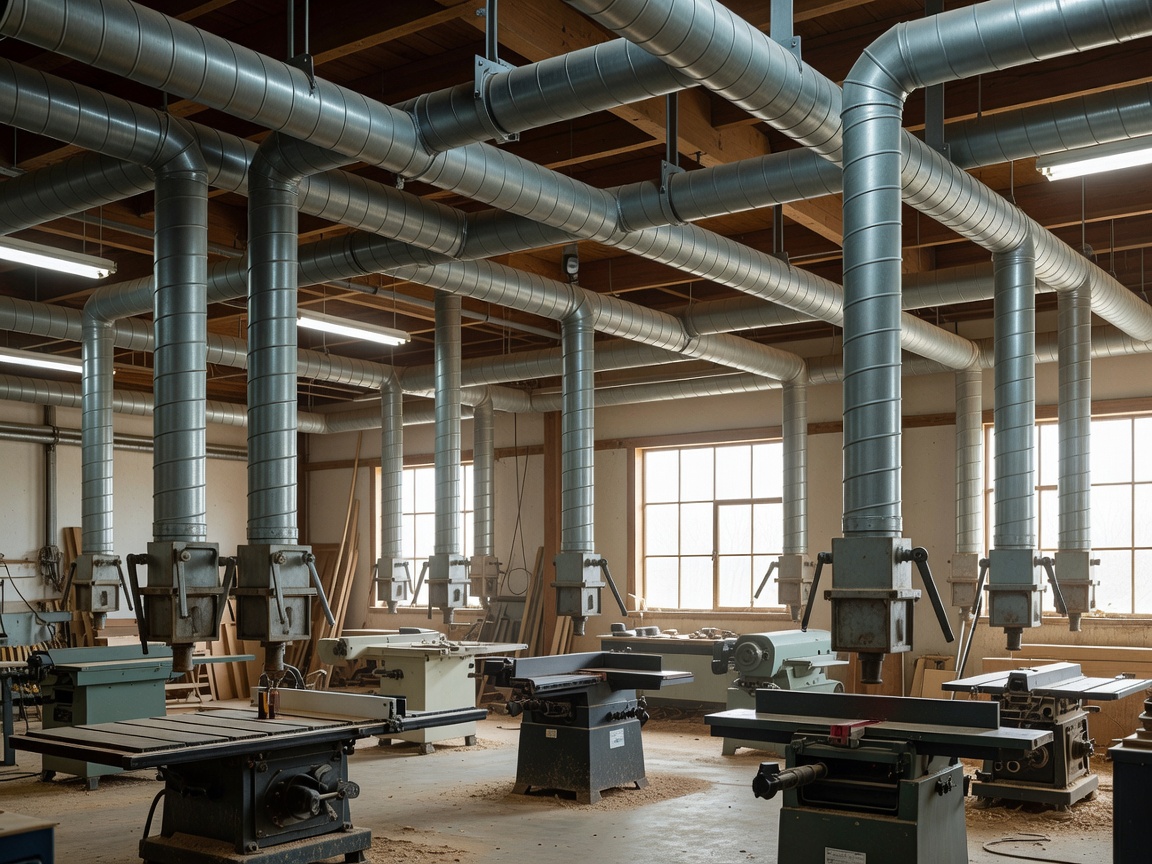
1. Air Velocity Fundamentals: Maintaining 4,000 FPM
A functional dust extraction layout does not simply move air; it maintains sufficient velocity to prevent heavy chips and dense particulate from dropping out of the airstream and clogging duct runs. In horizontal duct runs, air velocity must remain between 3,500 and 4,000 Feet Per Minute (FPM). In vertical risers, velocity must achieve at least 4,000 FPM to lift wood chips against gravity.
Air volume (measured in Cubic Feet per Minute, or CFM) is directly coupled to duct diameter. Running an oversized 8-inch main duct on an underpowered 1.5 HP collector causes air velocity to drop below 2,500 FPM, causing chips to deposit on the bottom of the pipe. Conversely, choking a high-volume cyclonic extractor down into restrictive 2.5-inch flex hose creates extreme friction loss, throttling air volume at the collection hood.
| Duct Diameter | Target CFM at 4,000 FPM | Friction Loss per 100 ft | Recommended Application |
|---|---|---|---|
| 4-inch (100 mm) | 350 CFM | ~6.2 inches W.G. | Single tool drops (Router table, bandsaw) |
| 5-inch (125 mm) | 545 CFM | ~4.8 inches W.G. | 12-inch Table saws, 8-inch jointers |
| 6-inch (150 mm) | 785 CFM | ~3.7 inches W.G. | Central trunk lines, 15-inch planers |
| 8-inch (200 mm) | 1,400 CFM | ~2.5 inches W.G. | Commercial multi-machine headers |
2. Static Pressure Loss (Inches of Water Gauge)
Total Static Pressure (SP) represents the total frictional resistance the collector's impeller fan must overcome. Static pressure is measured in inches of Water Gauge (W.G.). Every foot of straight pipe, every elbow, every blast gate, and every corrugated flex hose contributes to this resistance.
- Elbow Radius Geometry: Never use tight 90-degree plumbing elbows (T-fittings or short-radius ells). A standard 90-degree plumbing elbow can produce a static loss equivalent to adding 15 feet of straight pipe. Instead, employ long-radius sweep elbows (where centerline radius is at least 1.5 to 2 times the duct diameter) or pairs of 45-degree elbows separated by a straight transition section.
- Wye Junctions: Always connect branch drops to the primary trunk line using 45-degree lateral wyes rather than 90-degree tees to maintain laminar airflow.
- Flex Hose Restraint: Corrugated flexible hose exhibits up to three times the frictional drag of smooth-walled rigid ducting. Restrict flexible hose to the absolute minimum required for tool travel (ideally under 4 feet per machine).
Duct Substrate: Spiral Galvanized Steel vs Schedule 20/40 PVC
While ASTM D2729 thin-wall PVC pipe is economical, standard PVC acts as a dielectric insulator that accumulates massive static electric charges. For commercial production spaces and shops running high CFM systems, 24- to 26-gauge lock-seam galvanized spiral steel ducting remains the benchmark standard for longevity, fire safety, and impact resistance.
3. Static Dissipation & Grounding Infrastructure
As dry sawdust moves at high speed across internal duct walls, continuous friction strips electrons from particles, generating electrostatic charges exceeding 20,000 volts. While industrial deflagration requires an exact airborne dust-to-oxygen stoichiometric concentration, static charges in non-conductive PVC setups routinely deliver painful electric shocks to operators touching machine blast gates.
If utilizing rigid metal ducting, static grounding is achieved naturally by joining sections with self-tapping sheet metal screws and running a bare copper grounding wire (12 AWG or 14 AWG) from the steel ductwork directly back to the workshop's electrical service earth busbar. For non-conductive plastic duct runs, a bare copper wire must be run internally throughout the entire duct circuit and bonded directly to machine chassis grounding points.
4. Filtration Class: HEPA and 1-Micron Canister Standards
Traditional fabric filter collection bags act as dust pumps: they trap coarse wood chips while venting dangerous sub-micron particulate (0.5 to 2.5 microns) back into the shop air envelope. These fine particles remain suspended in ambient air for hours and penetrate deep into lung tissue.
Upgrade extraction systems with pleated spun-bond polyester canister filters rated at MERV 15 or higher (trapping 99.9% of particulate down to 1 micron). Ensure canister filters feature an internal manual or motorized beater paddle to dislodge caked dust cakes without damaging the delicate filter pleat membranes.