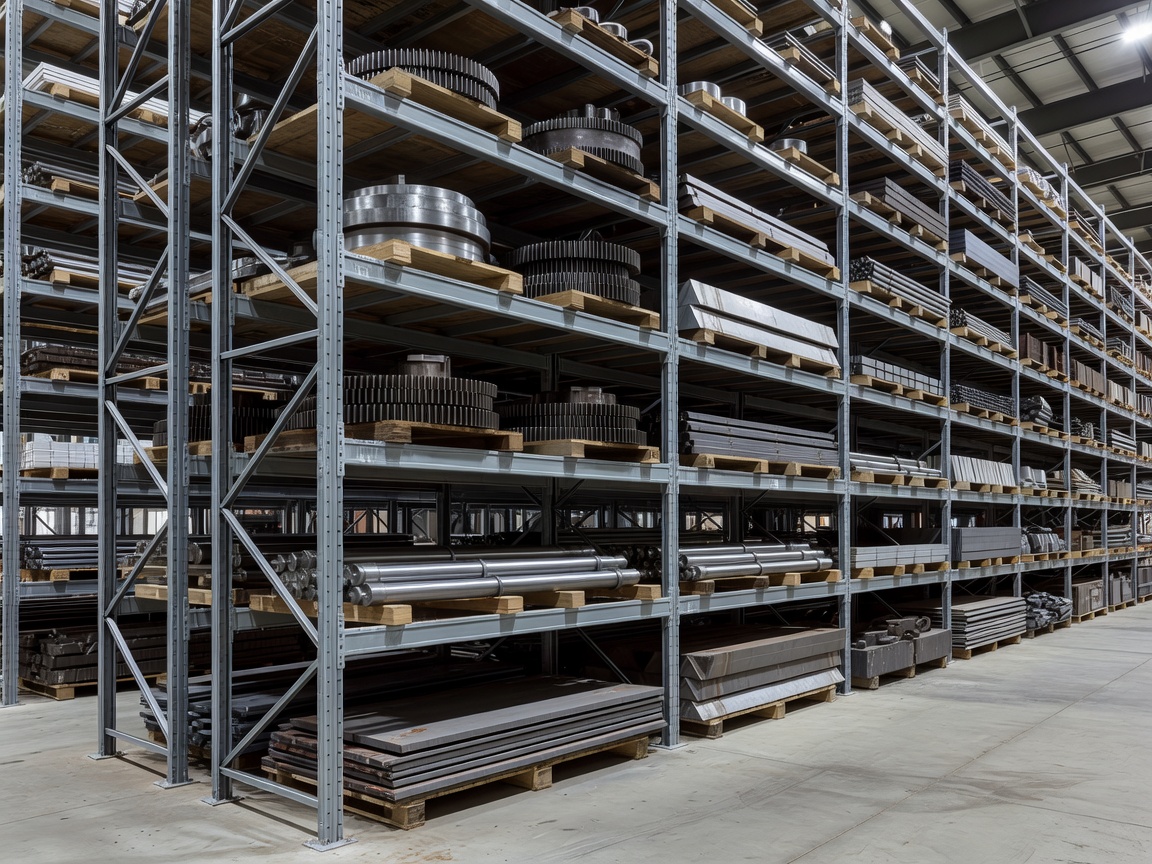
1. Structural Frameworks: Boltless vs Pallet Rack Profiles
In high-capacity residential and light industrial garages, residential plastic or lightweight wire shelving units quickly fail under point-loaded equipment such as engine blocks, transmissions, hydraulic jacks, or dense lumber storage. Workshop shelving requires cold-rolled commercial steel architecture.
Two primary profiles dominate high-capacity builds: industrial boltless rivet racking (using 14- to 16-gauge rolled angle posts) and teardrop pallet uprights (using 12- to 14-gauge structural C-channels). While boltless rivet racking provides versatile depth configurations (18 to 24 inches) suitable for standard plastic storage bins, teardrop racks provide structural spans up to 96 inches across with zero mid-span sag.
2. Beam Deflection Limits & Uniformly Distributed Load (UDL)
Shelving manufacturers rate capacities using the concept of Uniformly Distributed Load (UDL). A shelf rated for 2,000 lbs cannot support that weight concentrated onto a 4-inch contact surface in the exact center of the span; doing so exceeds the elastic yield limit of the steel channel and permanently deforms the beam.
Structural engineers adhere to the standard deflection criterion of L/240 (length of beam divided by 240). On a standard 72-inch span, maximum permissible deflection under full load is exactly 0.3 inches. When storing concentrated iron castings or heavy toolboxes, steel support cross-ties must be snapped into the horizontal step beams to distribute loads directly across the outer upright uprights.
| Racking Category | Steel Gauge | Max Shelf Load (UDL) | Decking Substrate |
|---|---|---|---|
| Rivet Boltless (Light-Med) | 16-Gauge | 600 lbs per shelf | 1/2" Particle Board or OSB |
| Industrial Channel (Heavy) | 14-Gauge | 1,500 lbs per shelf | Welded Steel Wire Decking |
| Mini-Pallet Rack (Extreme) | 12-Gauge | 3,000 lbs per shelf | Heavy 6-Gauge Wire Mesh |
| Cantilever Arm Rack | 10-Gauge Upright | 1,000 lbs per arm | Open Arm (Lumber / Pipe) |
3. Floor Slab Anchoring: Concrete Wedge Anchors
A freestanding rack with a height-to-depth ratio exceeding 4:1 poses a catastrophic tipping hazard if loaded unevenly or subjected to accidental lateral impacts from vehicles. Every heavy-duty shelving unit exceeding 72 inches in height must be mechanically secured to the concrete foundation slab.
- Anchor Specification: Use 3/8-inch or 1/2-inch zinc-plated steel concrete wedge anchors (minimum 3-3/4 inches in total length).
- Drilling Protocol: Use a rotary hammer drill with an ANSI-rated carbide masonry bit. Drill 1/2-inch deeper than the embedment depth to allow clearance for concrete dust.
- Torque Verification: Torque the hex nut to the manufacturer's specified value (typically 25 to 35 ft-lbs for 3/8-inch anchors). Under-torquing leads to pullout, while over-torquing fractures the concrete collar inside the slab.
Moisture Mitigation at Floor Level
Concrete garage slabs wick moisture via capillary action from the substrate beneath. Direct contact between raw steel footplates and concrete induces rapid electrolytic galvanic corrosion. Always seat high-density polyethylene (HDPE) shim pads or zinc barrier washers under footplates before torquing anchors down.
4. Decking Surface Selection: Wire Mesh vs Solid Plywood
Welded steel wire mesh decking offers distinct safety benefits over solid timber boards. Wire mesh permits overhead garage light to filter downward through multiple shelf levels, eliminating shadowed dead zones. More importantly, wire mesh prevents the collection of sawdust, wood shavings, and flammable debris, while allowing residential fire sprinkler water to penetrate down through all tiers without impedance.
Conversely, for storing small hardware containers, mechanics' sockets, and delicate instruments that might tip over on wire grids, 3/4-inch smooth ACX plywood treated with polyurethane or heavy-duty galvanized drop-in pans provide the ideal solid working substrate.
5. Operational Lifespan & Safety Audit Protocol
Perform semi-annual visual inspections on rack uprights. Any upright leg that exhibits an indentation or crease greater than 1/8-inch from an impact must be unloaded immediately and replaced; creased structural columns lose up to 70% of their critical axial buckling strength.