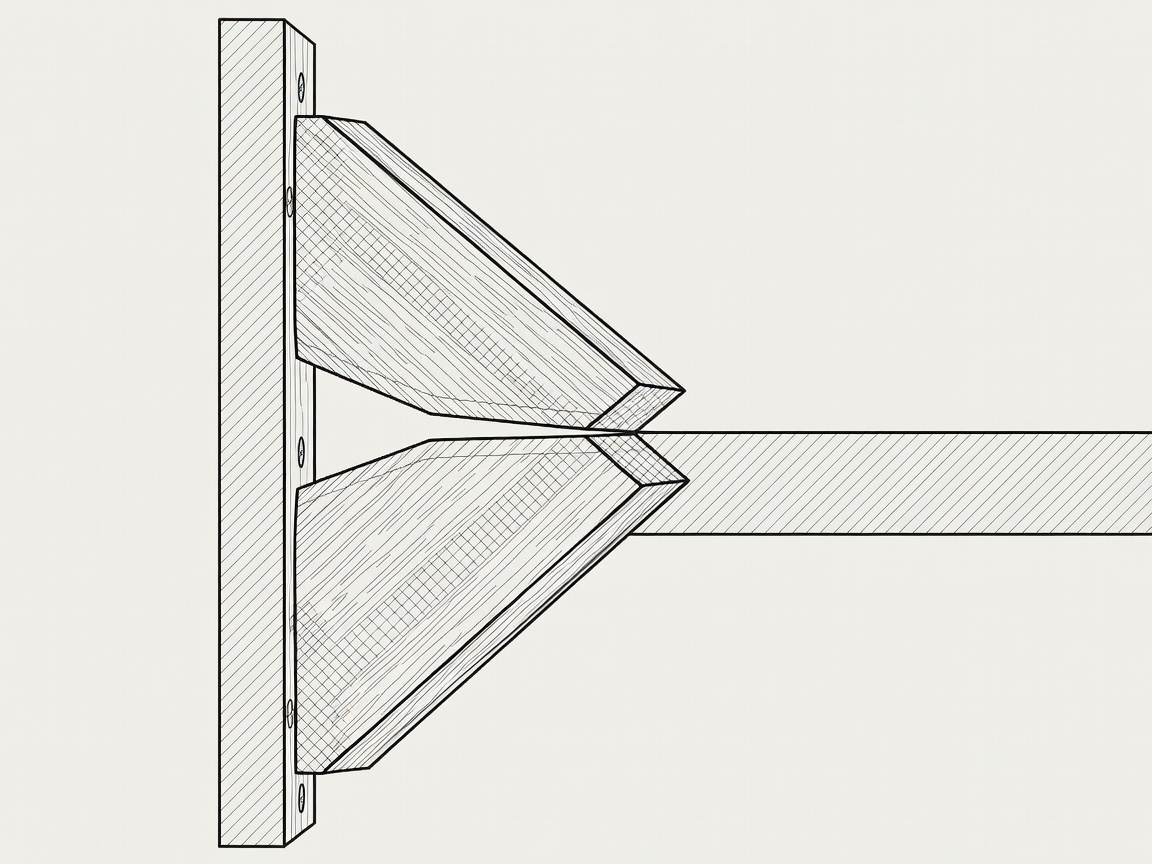
1. Fundamental Mechanics & Cleat Geometry
The French cleat relies on complementary 45-degree bevels that convert horizontal gravitational pull into downward wedge-locking pressure against the wall surface. When a modular tool bracket is engaged, the weight of the mounted equipment forces the cleat pair together, transferring shear loads directly into the wall studs.
Unlike standard pegboard systems that rely on 1/4-inch hooks resting in perforated hardboard, a properly fabricated wooden French cleat distributes load across an entire continuous horizontal linear run. This design prevents localized blowouts and allows heavy machine fixtures—such as bench grinders, drill press tables, and clamp racks—to hang securely without movement.
2. Substrate & Stock Selection: Plywood vs Solid Hardwood
Selecting the correct material for your wall cleats is crucial to ensure tensile strength along the beveled edge. Avoid medium-density fiberboard (MDF) and oriented strand board (OSB) entirely; neither offers sufficient internal ply integrity to prevent the bevel edge from shearing under shock loads.
- Baltic Birch Plywood (18mm / 3/4-inch): The industry benchmark. Featuring 13 void-free plies of solid birch, this material exhibits exceptional dimensional stability and will not cup, twist, or check across seasonal humidity swings.
- Cabinet-Grade Hardwood Plywood (3/4-inch): 7-ply core veneered with oak or maple. Readily accessible and provides adequate shear strength for general hand tool racks. Ensure the core lacks major interior voids before ripping bevels.
- Solid Hardwood (White Oak, Ash, or Hard Maple): Excellent for ultra-heavy hanging fixtures exceeding 150 lbs. However, solid wood requires thorough acclimation to the garage environment to prevent warping across continuous 8-foot lengths.
| Material Type | Nominal Thickness | Continuous Run Rating | Fastener Recommendation |
|---|---|---|---|
| Baltic Birch (13-Ply) | 18 mm (3/4 in) | 600 lbs per 8-foot rail | #10 x 3-1/2" GRK Cabinet Screws |
| Cabinet Grade Fir/Pine (7-Ply) | 19 mm (3/4 in) | 350 lbs per 8-foot rail | #10 x 3-1/2" Structural Wood Screws |
| Solid White Oak | 20 mm (4/5 in) | 750 lbs per 8-foot rail | 1/4" x 3-1/2" Structural Lag Screws |
| Extruded Aluminum Rail | 3 mm wall gauge | 900 lbs per 8-foot rail | 1/4" Zinc-Plated Pan-Head Lags |
3. Wall Fastening and Stud Layout Specifications
Garage walls in residential construction are typically framed with 2x4 or 2x6 timber studs spaced on either 16-inch or 24-inch on-center (OC) intervals. Cleats should never be attached to drywall alone with toggle bolts or hollow wall anchors when intended for heavy tool storage.
Each cleat rail must be anchored into at least three separate wall studs using two structural screws per stud intersection (spaced vertically 1-1/2 inches apart). We recommend 3-1/2-inch #10 structural washer-head screws. With 1/2-inch drywall and a 3/4-inch cleat thickness, a 3-1/2-inch screw provides 2-1/4 inches of direct thread penetration into the center of the framing member.
Critical Safety Metric: Stud Verification
Always verify stud centers with a deep-scanning magnetic and capacitive stud finder before drilling pilot holes. Never drive structural fasteners into the edges of studs where plumbing vents or 120V/240V NM-B electrical cables may run through drilled framing holes.
4. Design & Fabrication of Custom Tool Caddies
When engineering individual holders (for battery drills, chisels, hand planes, or pneumatic nailers), maintain a minimum backing plate height of 6 inches. A tall backing plate acts as a lever arm: the taller the plate, the greater the mechanical advantage resisting outward pull on the upper bevel cleat.
For modular brackets holding vibrating equipment (such as battery charging hubs or scroll saw blade racks), install a bottom spacer block on the caddy equal in thickness to the wall cleat. This ensures the caddy rests perfectly vertical and transfers horizontal forces flat against the wall face.
5. Advantages & Trade-Offs
System Advantages
- 100% modular reconfiguration without tool use.
- Infinitely scalable across any wall length.
- Custom brackets match exact tool geometries.
- Superior load capacity compared to plastic slotwall.
System Constraints
- Requires high-precision table saw bevel rips.
- Consumes wall depth (approx. 1-1/2 inches).
- Accumulates airborne sawdust on horizontal ledges.
- High initial sheet-good material cost.
6. Maintenance & Operational Longevity
In unconditioned garage environments subject to seasonal humidity variations, inspect rail fasteners annually. Torquing cycles caused by humidity-induced wood swelling and shrinkage can loosen lag fasteners by fractional turns. An annual spot check with a torque driver ensures structural integrity remains within rated safety thresholds.